

This post contains affiliate links. If you buy through one, Urgesta AS may earn a commission at no extra cost to you. Read the affiliate disclosure.
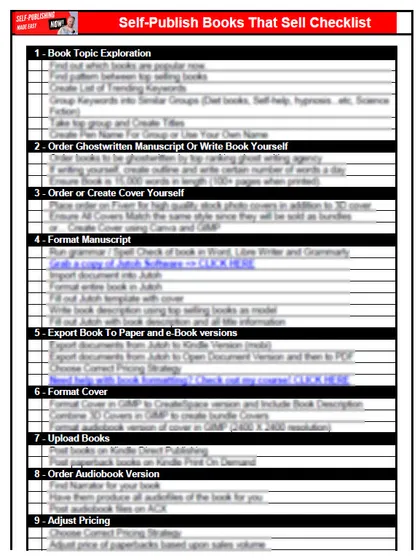
Get the free checklist: the 12 steps I follow for every book I publish.
To publish a book on Amazon, you need a cover, a formatted file, keywords, a description and a price, then you upload it through Kindle Direct Publishing (KDP). Amazon is the place I recommend beginners start. Below are the steps, the 2026 royalty rules and the thing most beginners skip: ads. If you would rather start from a ready-made layout, read how to self-publish on Amazon using a book template.
What Do You Need to Publish a Book on Amazon?
Beginners often don’t know where to start. Amazon is the biggest bookstore in the world, and if we want sales, that’s where we want to place the book first.
Before I start, check out my free 12-step self-publishing checklist, whether you’ve just started or have been publishing for a while.
When I first got started, I read books, listened to podcasts and took trainings, and everybody agreed that Amazon is the place for beginners. I quickly discovered how easy it is to get overwhelmed by all the choices: so many covers, descriptions and other things make it complex, and many people never get started. The question to ask first is: what is the first step to getting my book published?
You’ll need a few things to put a book on Amazon. First, a cover. Hire a cover designer on a freelance marketplace. If you have no budget, you can make a cover in Canva using its templates, although it takes more effort.
Which Formatting Program Should You Use?
Second, a good formatting program that pulls your cover and the contents together into a format you can publish as a Kindle book. I recommend Atticus. It’s the best I know of for producing the EPUB file you need, and later the PDF for your paperback with a click, with the table of contents flowing perfectly.
Which file format does KDP take? KDP recommends Word (DOC and DOCX), KPF files made with Kindle Create, and EPUB. It points to KPF as the way to avoid formatting problems and recommends checking any file in Kindle Previewer. As of March 2025 it no longer accepts MOBI for fixed-layout ebooks (KDP supported formats). For a children’s book, see how to self-publish a children’s book on Amazon Kindle.
Third, keywords. I didn’t include this step at first, but you need to know which keywords to target. I use KDSpy to find the right keywords for my book.
How Do You Price Your Book on Amazon?
Write your description, set the author name, which can be a pen name, and choose your price. For Kindle books on Amazon.com, a list price from $2.99 to $12.99 earns the 70% royalty. That band was $2.99 to $9.99 until 7 July 2026 (KDP: eBook list price rules). Outside it you earn 35%. For paperbacks, KDP pays 50% or 60% of the list price depending on the price (60% from $9.99 on Amazon.com), minus the printing cost (KDP: paperback royalty). I make sure I earn at least $5 per paperback sale, whatever the royalty. Never go below that. If you wonder whether a low price is worth it, read how authors who sell ebooks for 99 cents justify the time. Once the book is live, A+ Content and Author Central are the next places on Amazon to look at.
Do I Have to Fill In Tax Information Before I Publish?
Yes, wherever you live. KDP says it must receive and validate your tax identity before you can publish new books or update existing ones (KDP: Complete Tax Profile). If you live outside the US, KDP says “All non-US Person must complete a tax profile to be eligible to publish books on KDP.” Without a treaty rate, ebook sales on Amazon.com and print sales on Amazon.com, .co.jp, .com.au and .ca have 30% US tax withheld, and that includes Kindle+ payments from the KDP Select Global Fund. Your country may have a treaty with a lower rate, and a W-8 runs out at the end of the third calendar year after you sign it, when the rate goes back to 30% (KDP tax help). My advice: do the tax profile when you open the account, before the book is ready, so it doesn’t hold up your launch. That goes for everyone, in the US or not.
I live in the US. Why does KDP say my name and SSN don’t match IRS records?
If you use an SSN, KDP says to enter your name in the same format as on your Social Security card. A misspelled name, a missing middle initial or middle name, or a wrong number can cause a mismatch, and while the status is Incomplete you can’t publish or update books (KDP: What is my tax information status?).
When details don’t match IRS records, you have 30 days to update your tax profile before KDP suspends publishing. If the IRS only recently issued you a tax ID number, KDP says it can take up to 60 days to reach the IRS database (KDP: Complete Tax Profile).
Once your tax information is valid, KDP says a US person’s royalties aren’t subject to US tax withholding (KDP: Tax Withholding).
My advice: copy your name from the card letter for letter, before you submit the profile, so you don’t spend those 30 days fixing it. This is not tax advice.
What Does KDP’s Setup Look Like Today?
KDP’s Create a Book page splits setup into three parts. First, book details: on your Bookshelf you click Create, choose the book type, and fill in the title, authors, description, keywords and categories. Second, the content: you upload your manuscript, preview it and enter your ISBN, and for a paperback or hardcover you choose the print options before the preview. Third, rights and pricing: you set your price and royalty rate and agree to KDP’s Terms and Conditions. Your price can be changed at any time after publishing, but some book details can’t be changed once the book is live, and KDP lists them on its Update Your Book Details page. That is one more reason to get the title, subtitle and description right before you publish.
Why Shouldn’t You Make Your First Book Perfect?
Getting your first book perfect is a terrible idea. It will not be perfect and, even if it were, it would not sell by itself. You do not yet have the experience of getting a book out or the marketing skills to sell it. So get something okay or good onto Amazon, then practise. Build your audience and email list, and move on to the second book. Your readers tell you what they want, and slow sales tell you what to change.
My first KDP book in 2015 went badly because I made many mistakes. My top mistake was not understanding the audience. I started with something I was interested in, not with the reader’s problem, and my title and description were not clear. When I fixed that, sales rose. Since then I have seen people lose their accounts on Amazon, including low-content publishers who got frozen and removed, so I would start there but never stay only there. Being on several platforms is like the legs of a stool: if one goes, you do not tip over.
Plan around the new limit too: since 21-Sep-26, KDP allows two new titles per format per week, counted per format and reset every Sunday at 12:00 AM UTC (KDP; ALLi, 24-Sep-26). That is rarely a problem for one author. Check KDP’s current rule.
How Do You Get Your Book to Sell on Amazon?
The biggest secret is to run ads. You won’t make many sales from people randomly browsing Amazon. Most sales come from paid traffic, so plan on running Amazon ads against your book and see exactly how it’s doing. Some authors also enroll their ebook in KDP Select, which gives you promotion tools but requires that your ebook be exclusive to Amazon for 90 days. You can still put your paperbacks on IngramSpark and other places. Decide which suits your plan, and check KDP’s current rules.
The beauty of Atticus is that it makes it easy to take the same manuscript and the formatting you’ve done and export it in the other formats you need. You don’t need extra work beyond getting the covers to match. For the paperback cover templates, I use a free program called GIMP.
Don’t be overwhelmed by the whole thing. Start simple (and see how long a self-published book should be): use Atticus to format, get a cover done, put the cover and contents together into the EPUB file, upload it to Amazon, and start selling your book. Then run ads and see how it’s doing.
What have you found? Are there steps I missed, such as the description or the title, which is very important for getting people to look? Let me know in the comments.
Listen to this episode on Spotify
Frequently asked questions
How much does it cost to publish a book on Amazon KDP?
Publishing on KDP is free. You pay for what you choose to add, such as a cover designer, formatting software or ads. KDP deducts printing costs from paperback royalties.
What royalty do I earn on Amazon KDP?
For ebooks, 70% on list prices from $2.99 to $12.99 on Amazon.com (35% outside that band), minus delivery costs (KDP: eBook list price rules). For paperbacks, 50% or 60% of list price, depending on price, minus printing cost (KDP: paperback royalty).
Can I put my paperback on IngramSpark if my ebook is in KDP Select?
Yes. KDP Select requires your ebook to be exclusive to Amazon for 90 days, but your paperbacks can still be on IngramSpark and other places.
Do I need to fill in tax information before I publish on KDP?
Yes, wherever you live. KDP must receive and validate your tax identity before you can publish or update books (KDP: Complete Tax Profile). Non-US persons also need it for the withholding rate, and without a treaty rate 30% US tax is withheld from Amazon.com ebook sales (KDP tax help).
Do I need an ISBN to publish on Amazon?
Not for an ebook, where an ISBN is optional. For a paperback KDP gives a free ISBN, but it can only be used on KDP and the imprint shows as Independently published (KDP: ISBNs). To publish elsewhere, you need your own.
Start with the free checklist
The checklist is the 12 steps I follow for every book I publish, from choosing a topic that already sells to setting up the book's marketing. It is free, and you get it straight away.
You get the free checklist and Chris's emails. Unsubscribe any time. Privacy policy
Not sure yet? Book a free 25-minute call
Newest posts
Popular guides
- Lulu Self-Publishing Review 2026: Pros, Cons and Costs
- IngramSpark Review 2026: Free Setup, New Fees and Is It Worth It?
- Is Pegasus a Vanity Publisher? (2026 Update)
- Can You Sell Self Published Books On Etsy?
- How To Edit Your Books For Free With Grammarly
- Self Publishing Lulu VS Blurb?
- 5 Best Self Publishing Courses for Beginners (2026)
- How Long Should A Self-Published Book Be
- What Are The Minimum Amount Of Words For Paperback Books?
- Comparing Ingramspark, Lulu, and KDP Print
- How Many Books Do Self Published Authors Sell?
- Self-Publish For Under $199!