


This post contains affiliate links. If you buy through one, Urgesta AS may earn a commission at no extra cost to you. Read the affiliate disclosure.
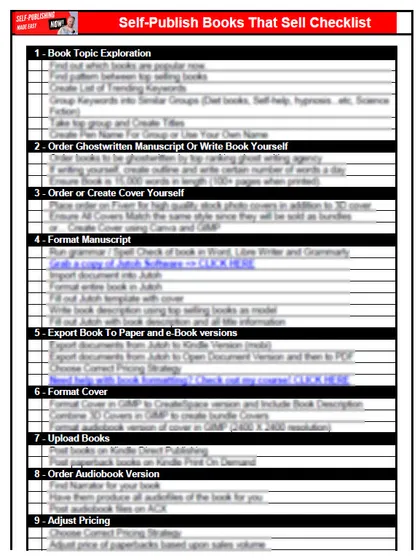
Get the free checklist: the 12 steps I follow for every book I publish.
A self-published book should be about as long as the best sellers in its type, so check those before you decide. Fiction and nonfiction differ a lot: Reedsy’s 2026 averages run from about 32,000 words for a self-improvement book to 93,000 for fantasy. For the short practical guides I publish I aim for 15,000 to 30,000 words, and my 3,000-word books still sell. This post covers length by type of book, what length does to your price and printing cost, and what I found when I tested it. For the hard page limits and the words-per-page sums, see the minimum word count for a paperback. If you want to know how long the whole process takes, see how long it takes to self-publish a book.
To see where your own word count sits for your genre, with the pages and print cost it means, use my word count by genre checker.
How long are books in each type?
Reedsy took the median length of the 8,890 manuscripts sent to it for copy editing in 2026, by category, and turned words into pages at 300 words a paperback page (Reedsy, posted 05-Nov-26). Treat these as typical lengths of books being edited, not rules. To turn your own word count into pages, try my book page count calculator.
| Type of book | Average words | Average pages |
|---|---|---|
| Fantasy | 93,000 | 310 |
| Romance, science fiction | 85,000 | 283 |
| Historical fiction, young adult | 76,000 | 253 |
| Mystery and crime | 70,000 | 233 |
| Horror | 55,000 | 183 |
| Middle grade | 31,000 | 103 |
| Biography and memoir | 51,000 | 170 |
| Business | 40,000 | 133 |
| Christian nonfiction | 34,000 | 113 |
| Self-improvement | 32,000 | 107 |
Reedsy’s list does not cover every niche. For the full fiction list and the older ranges, see what is a good word count. If your type is not on it, use the three steps further down to measure your own category.
How did I choose my own length?
When I wrote my first book I was shooting for 15,000 words. I think it ended up nearer 12,000, I can’t remember exactly. I also wrote a free giveaway for that first book, only 3,000 or 4,000 words long, to get people onto my email list. Then I started listening to other people, and they said longer books are better.
One of the people I was following at the time had written a 35,000-word book. He said it didn’t sell much more, but for my second book I went to 20,000 words. It was on sleep, and it became an Amazon bestseller and even came back to number one later. I’m not sure the length did that. I was getting better at choosing keywords and understanding my audience.
I was curious whether shorter books would sell, so I put the 3,000-word free book on the market too. The shorter books outperformed the longer ones. Even now my short book on email management often outsells my sleep book and my goals book. I was shocked by that.
Does your audience decide how long the book should be?
Yes. Different audiences expect different lengths, and the best guide is how long the top sellers in your niche are. My mistake was writing for too many audiences at once (sleep, goals, email and more), which made it hard to get any one of them right. I still get sales on all those books, but I would have done better sticking to one niche and becoming known for that one thing.
There are two ways to go. The first is to match the average length of the best sellers in your niche, which works for most authors. The second is to write short books and make it clear to readers that they are short. I still see my 3,000-word books selling.
How long should a novel be?
There is no set word count for a novel. In my view, readers of each genre expect a certain length, and the best guide is how long the top sellers in your genre are. The table above shows it: a mystery and a fantasy epic are over 20,000 words apart on average. KDP’s page limits, covered in the other post, tell you only what it will print, not how long a story should be.
To find the length for your own novel, use the three steps below on the category your novel would sit in, such as historical romance or science fiction adventure. Use the best sellers list, not the new releases. And ignore the one or two books far longer or shorter than the rest, because a famous author can get away with a length a new author cannot.
A novella is a shorter form of fiction, and it has its own rules of thumb about length and about selling in a series. If that is what you are writing, read how to publish a novella series.
If you are still unsure, my advice is to publish at the lower end of the range for your genre and watch the reviews. A reader who says the book felt too short tells you more than any chart. A book that feels padded gets the opposite complaint, so I would rather finish the story and stop.
What does book length do to printing cost and price?
It sets your printing cost, and on a paperback that comes straight out of your royalty. KDP prints a black ink paperback in a regular trim for $2.30 from 24 to 110 pages, and above 110 pages for $1.00 plus 1.2 cents a page. It pays 50% of the list price on Amazon.com at $9.98 or less and 60% from $9.99, minus printing cost (KDP printing costs; KDP paperback royalty). Here is that sum at three lengths, using those figures:
| Pages | Printing cost | Royalty at $9.99 | Royalty at $14.99 |
|---|---|---|---|
| 100 | $2.30 | $3.69 | $6.69 |
| 200 | $3.40 | $2.59 | $5.59 |
| 300 | $4.60 | $1.39 | $4.39 |
The royalty is 60% of the price minus the printing cost. Large trims, colour ink and other countries cost more, so check your own numbers in KDP’s royalty calculator before you publish.
The lesson for me is that a long book has to charge more to earn the same. I want a profit of at least $5 a book on paperbacks and hardcovers, and about $2 on Kindle books. A short book at a low price can still clear that, which is part of why my short ones work. Below $9.99 the royalty rate drops to 50%, so a very short paperback priced low earns less than you might expect.
Will readers accept a short book?
Often, if the listing is honest. Short books do risk bad reviews from readers who expected more. But the page count is on the listing, so it is not deceptive, and Amazon groups many of them as short reads. I’ve had plenty of readers tell me a short book helped them get into a subject quickly. If someone wants to train a puppy to sit, fetch and not jump on people, they do not need a thousand-page book.
How do you work out the right length in three steps?
- Look at the top-selling books in your genre. If you are writing a diet book, look at the diet books doing well. If you are writing fantasy, look at the bestsellers for your category or keyword on Amazon.
- Get the page counts for the top 20 and average them. The tool I like for this is KDSpy (a one-time purchase). Type in your keyword and sort by overall sales rank.
- Match that length. Those books get good reviews because readers are not dissatisfied with the length. Remember a paperback needs at least 24 pages and a KDP hardcover at least 75. My KDP royalty calculator shows what a page count does to your print cost and royalty.
If you write too much, readers wear out and complain it is too long. If you write too little, they say they did not get enough value. Some readers want a quick answer, others want a long story told thoroughly.
What did Steve Scott teach me about book length?
Steve Scott played a big part in my early years of self-publishing. He told me to test different lengths for my target audience, and I had not even chosen one. He was pushing 30,000-word books, saying the longer the book, the more satisfied readers would be. In the early days Amazon rewarded every download, so lots of short books raised profit. Amazon later paid KDP Select (Kindle Unlimited) books by pages read, which hurt many short books. I have not re-checked how Amazon pays today, so look at KDP Select’s current terms.
Early on I tried 10,000 words, then 20,000 to 30,000, and my sales were not great. Then I gave 3,000-word books one last try, ran ads and content marketing, and they outsold the longer ones. People were happier with a short book that solved their problem at an affordable price. Let the data tell you what to do.
How do I find the right length for my own niche?
Test different lengths instead of deciding there is one right length and sticking to it. Look at what is selling in your niche now, publish, and see what your readers buy. You can also bundle short books together: four 3,000-word books on the same subject make a bundle of close to 100 pages. A bundle also works as an audiobook, and audiobooks turned out to make me more money than I expected.
My biggest mistake was spreading myself over 10 or 15 niches. Sticking to one would have let me build more expertise and a better email list, and you only learn those things once your book is on the market. So get your first book out, and if you want the steps in order, use my free 12-step self-publishing checklist.
How many pages are in your books? Tell me below in the comments.
Listen to this episode on Spotify
Frequently asked questions
How many words should a self-published nonfiction book be?
Match the best sellers in your niche. Reedsy's 2026 averages are about 32,000 words for self-improvement and 34,000 for Christian nonfiction (Reedsy). For short practical guides I aim for 15,000 to 30,000 words, and my 3,000-word books still sell.
How long should a novel be?
Reedsy's 2026 averages run from 55,000 words for horror to 93,000 for fantasy, with most genres between 67,000 and 85,000 (Reedsy). See what is a good word count for more.
Can a book be too short?
It can get bad reviews if readers expect more, so say clearly in the listing how short it is. Some readers like a short book that solves their problem quickly.
Does a longer book cost more to print?
Yes. On KDP, a black ink paperback over 110 pages costs $1.00 plus 1.2 cents a page to print in a regular trim, so 300 pages costs $4.60 (KDP printing costs).
Start with the free checklist
The checklist is the 12 steps I follow for every book I publish, from choosing a topic that already sells to setting up the book's marketing. It is free, and you get it straight away.
You get the free checklist and Chris's emails. Unsubscribe any time. Privacy policy
Not sure yet? Book a free 25-minute call
Newest posts
- IngramSpark Standard vs Premium Color: Which Interior for Your Book?
- Which AI Should You Use to Write and Self-Publish a Book?
- What Can I Do Before My Manuscript Is Finished? Five Jobs to Start Now
- How Should I Title My Book's Chapters?
- Atticus or Reedsy Studio: Which Should You Use to Format Your Book?
Popular guides
- Lulu Self-Publishing Review 2026: Pros, Cons and Costs
- IngramSpark Review 2026: Free Setup, New Fees and Is It Worth It?
- Is Pegasus a Vanity Publisher? (2026 Update)
- Can You Sell Self Published Books On Etsy?
- How To Edit Your Books For Free With Grammarly
- Self Publishing Lulu VS Blurb?
- 5 Best Self Publishing Courses for Beginners (2026)
- What Are The Minimum Amount Of Words For Paperback Books?
- Comparing Ingramspark, Lulu, and KDP Print
- How Many Books Do Self Published Authors Sell?
- Self-Publish For Under $199!