

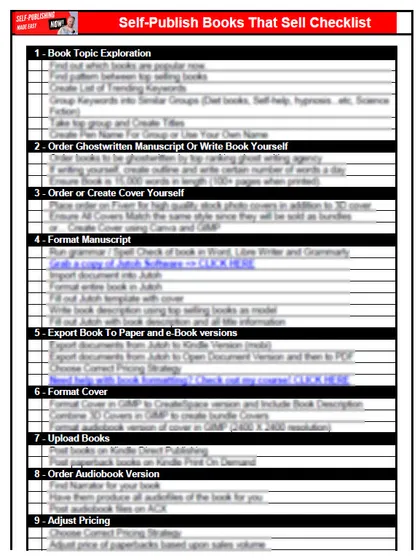
Get the free checklist: the 12 steps I follow for every book I publish.
Table of Contents
Many famous authors started by publishing their book themselves or through a small press, then moved to a big publisher once readers had shown they wanted it. Below are 15, with what actually happened to each. Not all of them self-published in the strict sense, and I say where they did not. The point is that self-publishing does not lock you out of a traditional deal, and you can also just stay self-published.
| # | Author | How they started | What came next |
|---|---|---|---|
| 1 | Hugh Howey | Began Wool with a small press, then chose Kindle Direct Publishing | 2012 Simon & Schuster print deal, kept his ebook rights |
| 2 | Robert Kiyosaki | Self-published Rich Dad Poor Dad in 1997 | Warner Books in 2000, over 32 million copies |
| 3 | Lisa Genova | Self-published Still Alice through iUniverse in 2007 | Simon & Schuster in 2009, Oscar-winning film |
| 4 | Wayne Dyer | Traditional publisher, but promoted the book himself | Dozens of books |
| 5 | Irma Rombauer | Paid for 3,000 copies of Joy of Cooking in 1931 | Bobbs-Merrill in 1936, over 20 million copies |
| 6 | Andy Weir | Free serial on his website, then Kindle at 99 cents | Crown bought it in 2013, film in 2015 |
| 7 | Beatrix Potter | Paid for 250 copies of Peter Rabbit in 1901 | Frederick Warne in 1902 |
| 8 | Mark Twain | Founded his own publishing company | Published Huckleberry Finn (US) and Grant’s memoirs |
| 9 | Stephen King | Not self-published; Carrie came out through Doubleday in 1974 | Over 60 novels |
| 10 | E.L. James | Fan fiction, then ebook and print on demand from a small press in 2011 | Vintage in 2012, over 150 million copies of the trilogy |
| 11 | Michael J. Sullivan | Self-published the Riyria books 2008 to 2011 | Orbit omnibus editions 2011 to 2012 |
| 12 | John Grisham | Not self-published; a small press printed 5,000 copies of A Time to Kill | Major publisher, over 300 million books in all |
| 13 | John Locke | Self-published ebooks on Kindle | First self-published author to sell a million ebooks |
| 14 | William P. Young | Printed 15 copies, then published The Shack in 2007 | No. 1 on the New York Times list in 2008 |
| 15 | Christopher Paolini | His parents self-published Eragon | Knopf in 2003 |
Which famous authors started in self-publishing, and what happened?
If you’re deciding between self-publishing and a traditional deal, the fear is that you will get stuck on the self-publishing side. These stories show the opposite. You can start by self-publishing, and if a publisher wants you, you can move over. Or you can stay. Many of them also won attention through awards, and there are plenty of book awards for self-published authors today. For more stories, see Amazon Kindle self-publishing success stories.
1. Hugh Howey. He began Wool as a short story in 2011, first with a small press, and then chose Kindle Direct Publishing for the freedom. Per Wikipedia, in 2012 Simon & Schuster took the print distribution to bookstores in the US and Canada while he kept selling the ebook himself. He turned down seven-figure offers to keep his ebook rights.
2. Robert Kiyosaki. One of my favorite authors on entrepreneurship. Rich Dad Poor Dad was self-published in 1997, then published by Warner Books in 2000, and has sold over 32 million copies. Publishers reportedly turned it down at first. I have read around 20 of his books.
3. Lisa Genova. An American neuroscientist with a Harvard PhD. Still Alice was self-published with iUniverse in 2007 and Simon & Schuster released it in January 2009. The 2014 film won Julianne Moore the Academy Award for Best Actress.
4. Wayne Dyer. The self-help author is not a classic self-publishing example. Wikipedia does not name the publisher of Your Erroneous Zones, but it says that after the book appeared he quit teaching and toured doggedly for bookstore and media appearances. It shows how much an author can do for his own book.
5. Irma Rombauer. Her Joy of Cooking started in the Great Depression to help families cook affordably. She paid a St. Louis printer for 3,000 copies in 1931. Bobbs-Merrill published an expanded edition in 1936, and the book has sold more than 20 million copies. I own it.
Do self-published books ever become big hits?
6. Andy Weir. The Martian began as a free serial on his website. Fans asked for an ebook, so he priced the Kindle edition at 99 cents, the lowest Amazon allowed. It climbed Amazon’s science fiction list and Crown bought the print rights in March 2013. The Ridley Scott film with Matt Damon came out in October 2015. One of my favorite science fiction books.
7. Beatrix Potter. She had The Tale of Peter Rabbit printed for family and friends at her own expense in December 1901, 250 copies, after failing to find a buyer. Frederick Warne issued the trade edition in 1902. Her books together have sold more than 250 million copies. I grew up with them.
8. Mark Twain. His early books came through regular publishers, but he founded Charles L. Webster and Company in 1884, which published the US edition of Huckleberry Finn in 1885 and Ulysses S. Grant’s memoirs. So he published his own work. He is known for satire and humor.
9. Stephen King. Not a self-publishing story. Doubleday published Carrie on 5-Apr-74. As a boy he sold small homemade publications, including a newspaper with his brother. He has written over 60 novels, and I have read many. On Writing is a good read for aspiring authors.
10. E.L. James. Fifty Shades of Grey began as fan fiction and came out in 2011 as an ebook and print on demand from The Writers’ Coffee Shop, an Australian small press. Vintage Books re-released it in 2012, and the trilogy had sold over 150 million copies by October 2017. You can sell a lot of books starting small outside the big houses.
What can you learn from these authors?
11. Michael J. Sullivan. His Riyria books, from The Crown Conspiracy to Percepliquis, were self-published from 2008 to 2011, and Orbit published omnibus editions in 2011 and 2012. The series has been translated into fourteen languages. One of the most successful independent fantasy authors. I haven’t read his books yet.
12. John Grisham. A Time to Kill was rejected by 28 publishers before a small press, Wynwood, agreed to print 5,000 copies. Wikipedia gives both 1988 and 1989 for the date. It was not self-published, but the pattern is the same: a small start, proof that readers wanted it, then a major publisher. His books have sold more than 300 million copies. I have seen most of the films, and I listened to The Rainmaker as an audiobook on a trip.
13. John Locke. Known for the Donovan Creed thrillers and the Emmett Love westerns. He is called the first self-published author to sell one million ebooks, and he kept control of design and pricing even when he made a paperback distribution deal with Simon & Schuster. One of the pioneers of indie publishing. I haven’t read his books.
14. William P. Young. The Shack was meant only for his six kids and a few close friends. He printed 15 copies, and after 26 publishers rejected it he and two friends published it in 2007 through their own company, Windblown Media. It reached No. 1 on the New York Times trade paperback fiction list in June 2008. I haven’t read it.
15. Christopher Paolini. He started Eragon as a hobby at 14. His parents published it through their home company, Paolini International, in 2001 or 2002 (Wikipedia gives both). Carl Hiaasen’s stepson bought a copy at one of his talks and loved it, Hiaasen took it to Knopf, and Knopf published it in August 2003. My kids have read the whole Inheritance Cycle.
What do they have in common?
A small start, proof that readers wanted the book, and then a bigger deal or bigger sales. Once you have proven an audience, you can get a good contract if you want one. Some people don’t want to give up the royalties, and that is fine. I weigh up the two routes in is it better to self-publish a book. The problem is many self-publishers never get that far.
Did I forget any major self-published author the average person would know? Tell me in the comments.
Every one of them started by getting a first book out. To see how Amazon’s rules work before you start, read the Amazon Kindle self-publishing guidelines, then follow my free 12-step self-publishing checklist to get your own book onto the market.
Frequently asked questions
Which famous authors started out self-published?
This list has 15, including Hugh Howey, Robert Kiyosaki, Lisa Genova, Andy Weir, Beatrix Potter, E.L. James and Christopher Paolini. Not all of them self-published in the strict sense, and I say where they did not.
Did Andy Weir self-publish The Martian?
It began as a free serial on his website. Fans asked for an ebook, so he priced the Kindle edition at 99 cents. Crown bought the print rights in March 2013, and the film came out in October 2015.
Can a self-published author still get a traditional deal?
Yes. Lisa Genova self-published Still Alice in 2007 and Simon & Schuster released it in January 2009. Hugh Howey took a print deal in 2012 and kept his ebook rights.
Were Stephen King and John Grisham self-published?
No. Doubleday published Carrie. A small press, Wynwood, printed 5,000 copies of A Time to Kill. The pattern is the same: a small start, proof that readers wanted it, then a major publisher.
Do I have to move to a traditional publisher?
No. Once you have proven an audience you can get a good contract if you want one, but some people don't want to give up the royalties, and that is fine.
Start with the free checklist
The checklist is the 12 steps I follow for every book I publish, from choosing a topic that already sells to setting up the book's marketing. It is free, and you get it straight away.
You get the free checklist and Chris's emails. Unsubscribe any time. Privacy policy
Not sure yet? Book a free 25-minute call
Newest posts
- IngramSpark Standard vs Premium Color: Which Interior for Your Book?
- Which AI Should You Use to Write and Self-Publish a Book?
- What Can I Do Before My Manuscript Is Finished? Five Jobs to Start Now
- How Should I Title My Book's Chapters?
- Atticus or Reedsy Studio: Which Should You Use to Format Your Book?
Popular guides
- Lulu Self-Publishing Review 2026: Pros, Cons and Costs
- IngramSpark Review 2026: Free Setup, New Fees and Is It Worth It?
- Is Pegasus a Vanity Publisher? (2026 Update)
- Can You Sell Self Published Books On Etsy?
- How To Edit Your Books For Free With Grammarly
- Self Publishing Lulu VS Blurb?
- 5 Best Self Publishing Courses for Beginners (2026)
- How Long Should A Self-Published Book Be
- What Are The Minimum Amount Of Words For Paperback Books?
- Comparing Ingramspark, Lulu, and KDP Print
- How Many Books Do Self Published Authors Sell?
- Self-Publish For Under $199!