

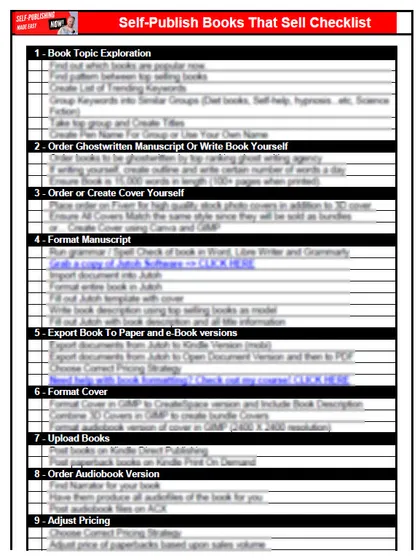
Get the free checklist: the 12 steps I follow for every book I publish.
For self-publishing, Lulu versus Amazon comes down to using both, but start with Amazon. Amazon has the readers who are looking for books, so get your Kindle ebook and paperback live on KDP first. Then add Lulu as a second source for print, and add IngramSpark and Draft2Digital to spread wider. Below is how the two compare on cost, royalties and where each one sells, and the order I would do it in.
Before you pick platforms, grab my free Self-Publishing Checklist. It has the 12 steps to get your books produced and selling.
Which is better for self-publishing, Lulu or Amazon?
Amazon is better as your first platform, and Lulu is a good second one. You should not choose only one. On KDP you can do Kindle ebooks, paperbacks and hardcovers. Audiobooks go through ACX, Amazon’s audiobook service. Lulu is a second option for print, and it is useful if you want books sold outside Amazon or want to order copies to sell yourself.
When I got started, I asked a lot of people where to put my books. They said the largest market of people looking for specific books was Amazon, and they were right. People on Amazon come to buy books, and it is one of the biggest search engines there is. So that is where my books went first.
How do Lulu and Amazon compare?
| Format | Amazon (KDP and ACX) | Lulu |
|---|---|---|
| Ebook | Yes, Kindle | Yes |
| Paperback | Yes | Yes |
| Hardcover | Yes, 75 to 550 pages (KDP) | Yes |
| Audiobook | Through ACX | No |
| Cost to publish | Free | Free; $4.99 one-time review fee for Global Distribution |
| Free ISBN | Yes for print, works only on KDP | Yes, Lulu is listed as the publisher |
| Where it sells | Amazon | Lulu’s own store, plus other stores through Global Distribution |
| Print royalty | 60% of list price minus printing cost at $9.99 and up, 50% at $9.98 and below (Amazon.com) | 80% of gross profit |
Amazon’s free ISBN only works on Amazon, and Lulu’s only on Lulu. One that works on both KDP and IngramSpark: publish under my imprint, Urgesta AS, and you get the ISBN and barcode within 2 business days.
What is the big problem with Amazon?
When I started, Amazon did not print hardback books. That was the big problem. KDP now offers hardcover print on demand, so you can sell paperback and hardcover from the same KDP account. Hardcovers need between 75 and 550 pages (KDP hardcover specs).
Back then I talked to people who had tried it, and they told me certain readers only buy hardback books. If you don’t have one, those readers buy your competitor’s book instead. I am a bit like that myself. I enjoy Kindle books and audiobooks, but with some books, if there is only a paper copy I won’t buy it. There are millions of people like that.
So I looked at where to do hardbacks. I checked IngramSpark, Lulu and a few others. For years I made hardback sales on Lulu every month. Today I do my hardcovers on KDP and IngramSpark, and I use Lulu only to spread my books wider. The lesson was to give your audience the format they want and make it easy to buy. For more on hardcovers, see my hardcover manual. I also put Lulu next to Blurb in Lulu versus Blurb.
How much does it cost to publish on Lulu?
Publishing on Lulu is free. You pay for printing when you order a proof or copies, and your book is printed only when someone orders it. Hardcovers usually take longer to print than paperbacks. You can get a free ISBN from Lulu in the publishing steps. Lulu is then the listed publisher of that ISBN, and it stays with Lulu if you move the book elsewhere (Lulu on ISBNs). If you want your own imprint, buy your own ISBN.
If you add Global Distribution, Lulu charges a one-time, non-refundable $4.99 review fee the first time you submit a title (Lulu Global Distribution). You approve a proof copy first. Lulu says it can take about 12 weeks or longer before the book shows up at retailers, and the retailers decide whether to list it. You can read more in where to find the Lulu login.
How much do Lulu and Amazon pay you?
On Amazon.com, KDP pays 60% of the list price minus printing cost on paperbacks priced $9.99 and up, and 50% at $9.98 and below (KDP paperback royalty). Hardcovers use the same two rates (KDP hardcover royalty). Paperbacks sold through KDP Expanded Distribution pay 40% of list price minus printing cost (KDP paperback royalty).
Lulu works differently. Your share is 80% of gross profit, which is the price minus the print cost and any distribution fee. Sales through Global Distribution lose 50% of the retail price to the channel first, so you earn much less per copy there than in Lulu’s own store. Lulu also says the list price must be at least twice the print cost (Lulu creator revenue guide).
For audiobooks, ACX’s new royalty model since 26-May-26 pays 50% for exclusive distribution and 30% for non-exclusive. Titles still on the legacy model earn 40% and 25% until the end of the year (ACX royalties).
Where does Lulu sell, and does it reach Amazon?
Lulu sells in its own bookstore, and through Global Distribution it can list eligible books with Amazon and Ingram. The retailers make the final decision. Lulu says Amazon does not accept any hardcover products, so a Lulu hardcover will not appear on Amazon through Lulu (Lulu help). If you want a hardcover on Amazon, use KDP.
IngramSpark is the other big print option. It does not charge book setup fees, and revisions are now free (IngramSpark director’s letter). It does charge a global distribution fee of 1.875% of the local list price on each sale, effective 1 February 2026 (IngramSpark 2026 rate card). Check IngramSpark’s current price guide before you publish.
In what order should you publish on each platform?
Don’t do everything at once. Keep it simple and add one platform at a time.
- Get your Kindle ebook live on KDP.
- Add the paperback on KDP.
- Get a narrator and make the audiobook through ACX. See where to find a professional narrator.
- Add the hardcover on KDP and IngramSpark, plus Lulu if you want one more print source.
- Put your EPUB on Draft2Digital to get it into other ebook stores. Draft2Digital took over Smashwords in 2022.
- Add paperbacks on IngramSpark.
The aim is that when people search, your book keeps coming up in different places. Amazon is the place to start, but you should not stop there. Amazon can close or suspend a KDP account if it thinks you broke its rules, so keep your files and have your books on other stores too. If one account has a problem, the rest of your income keeps coming in.
Have you published on Lulu, Amazon or both? Tell me in the comments. Check my other posts and videos for more answers to your self-publishing questions.
Listen to this episode on Spotify
Frequently asked questions
Can I publish the same book on both Lulu and Amazon?
Yes. You can publish on KDP and on Lulu at the same time. Lulu's free ISBN stays with Lulu and KDP's free ISBN works only on KDP, so each platform gives the book its own ISBN unless you buy one yourself.
Does Lulu charge to publish a book?
Publishing on Lulu is free. You pay for printing when you order a proof or copies, and Lulu charges a one-time, non-refundable $4.99 review fee the first time you submit a title to Global Distribution (Lulu Global Distribution).
Can I sell a Lulu hardcover on Amazon?
Not through Lulu. Lulu says Amazon does not accept any hardcover products (Lulu help). To sell a hardcover on Amazon, publish it on KDP.
Start with the free checklist
The checklist is the 12 steps I follow for every book I publish, from choosing a topic that already sells to setting up the book's marketing. It is free, and you get it straight away.
You get the free checklist and Chris's emails. Unsubscribe any time. Privacy policy
Not sure yet? Book a free 25-minute call
Newest posts
Popular guides
- Lulu Self-Publishing Review 2026: Pros, Cons and Costs
- IngramSpark Review 2026: Free Setup, New Fees and Is It Worth It?
- Is Pegasus a Vanity Publisher? (2026 Update)
- Can You Sell Self Published Books On Etsy?
- How To Edit Your Books For Free With Grammarly
- Self Publishing Lulu VS Blurb?
- 5 Best Self Publishing Courses for Beginners (2026)
- How Long Should A Self-Published Book Be
- What Are The Minimum Amount Of Words For Paperback Books?
- Comparing Ingramspark, Lulu, and KDP Print
- How Many Books Do Self Published Authors Sell?
- Self-Publish For Under $199!