
Get the free checklist: the 12 steps I follow for every book I publish.
For most authors the best self-publishing platform is Amazon KDP, with IngramSpark added for wider print distribution. Publish both in your own accounts, so you can see your sales and change your prices and metadata yourself. Below is an author whose hybrid publisher had put her books on IngramSpark, and what we fixed.
What is the best self-publishing platform?
Amazon is by far the best, and nothing beats it for reach. I recommend IngramSpark in addition, for paperbacks and hardcovers, and Lulu is another option for hardbacks. IngramSpark books earn me more than my paperbacks on Amazon.
What matters more than the platform is that the account is yours. You want to control the price, run ads and see the sales those ads bring. After running over 200 million ad impressions myself for my 230 books on Amazon, I can tell you ads are one of the most powerful ways to get a book to sell. They only work if you can see and change things.
What went wrong for Amy?
Amy is an author in California with a couple of books. She had gone through a hybrid publisher, who put the paperbacks on IngramSpark. She could see the books showing up on Amazon, but she couldn’t change the prices or some of the metadata, and she couldn’t run ads as easily. Nobody was buying, and she started to doubt she could write books people wanted to read.
The hybrid did a few things right. They took her book in its existing format, helped with a cover and put it on IngramSpark. And it went into her account, not theirs. In some hybrid deals the publisher uploads the book to their own account, so only they know what you sell and how much they wish to send you. That is a ridiculous situation, and you don’t get that information even if you run ads. Amy was fortunate.
One tip before you sign with any hybrid publisher: ask in writing that the books go into your own IngramSpark and KDP accounts, that you can see the sales reports, and that you can change the price and the metadata yourself. I wrote about other warning signs in best self-publishing companies.
She also had no ebook. She thought books were just about the paperback, and she was wrong.
What did we find in her discovery session?
She had watched my videos and booked a free 25-minute discovery session. We found a few things:
- Her book was on Amazon only because IngramSpark distributed it there. She wasn’t registered through Amazon KDP herself.
- There was no Look Inside, so a buyer couldn’t preview the book.
- Her name on Amazon led nowhere, because she had no Amazon author page.
- She couldn’t adjust the price. Pricing is one of the most important things: as sales grow, you raise the price step by step. Without control over price, that is a big problem, especially on Amazon.
IngramSpark title setup is free, and revisions have been free since 01-Feb-26 (IngramSpark help). When your book is enabled for distribution, IngramSpark takes a global distribution fee of 1.875% of the local list price on each sale, on top of the print cost for each copy (IngramSpark 2026 rate card).
What did she do about it?
The fix was an Amazon KDP account. She would ask Amazon whether she could adjust prices and add an author bio even though the book came through IngramSpark. I haven’t seen this setup before, so I’m following up with her to find out whether that is possible. She would also publish an ebook on KDP.
With the ebook on Amazon, she could look at an audiobook too. ACX is open to residents of the United States, United Kingdom, Canada and Ireland, so living in California is no problem for Amy (ACX help). For authors elsewhere, INaudio (the old Findaway Voices) distributes audiobooks to most stores, and Spotify for Authors puts them on Spotify (ALLi). Don’t sit on manuscripts.
She also decided to format her own books with a tool like Atticus, so she can make changes herself. Her hybrid publisher would charge about $100 for a change, because it isn’t worth their time. The downside is that she has to learn more about formatting, which we discussed in the session.
Her ads work like this: one set for the Kindle version and one for the paperback. The Kindle ads drive people to the sales page, and then many buy the paperback. Nearly every author I know makes about twice as much money on paperbacks as on Kindle. Amazon’s audience is massive, and if you don’t optimize your sales page, buyers go to authors who did.
As we last spoke, she was setting up her Amazon KDP account. She felt a lot better and could see a direction for getting her books into more formats and in front of a larger audience.
Which platforms are best in 2026?
| Platform | Best for | Cost, from the platform’s own pages |
|---|---|---|
| Amazon KDP | Ebook, paperback, hardcover; the biggest audience | Royalties 35% or 70% on ebooks, 50% or 60% on print minus printing cost |
| IngramSpark | Wider paperback and hardcover distribution | Free to sign up and upload, no setup fee, and a global distribution fee of 1.875% of list price since 1-Feb-26 |
| Draft2Digital | Ebooks in other stores, and some print | $20 one-time activation fee, $12 a year if you earn under $100 a year, about 10% of retail price on ebook sales; print pays about 45% of list price minus printing |
| PublishDrive | Wider ebook reach | Subscription, no commission on paid plans; one ebook free to Apple Books, Barnes & Noble and Kobo |
| ACX | Audiobooks on Audible | Needs your book on Amazon first. 50% exclusive, 30% non-exclusive under the new model (page dated 31-Jul-26) |
| Lulu | Hardcovers | Order one proof first. It has been my hardcover option; check Lulu’s current terms |
In the old days I told you to use Smashwords. Draft2Digital took it over in March 2022, so I would go with Draft2Digital.
Why start with Amazon KDP?
Because it is free and the people there have their credit cards attached to their accounts, ready to buy. It lets you upload a corrected file or a new cover after the book is live, though KDP locks some details, such as a paperback title, soon after publication. Many authors I coach are so focused on the other sites that they still have no book on KDP. Get it on KDP first, do nothing else until it is live, then add one platform at a time. See is KDP self-publishing right for you?.
Does ACX make me sell only on Audible?
Only if you pick exclusive distribution, which Royalty Share deals require. Under ACX’s new model, which applies to new users from 26-May-26, exclusive pays 50% and non-exclusive pays 30%, up from 40% and 25% under the legacy model, which ends by the end of the year (ACX). In a Royalty Share deal you split the royalties with the producer. Read the deal terms before you accept either.
Why not put everything on one platform?
Selling on one platform leaves money on the table. If your Amazon account is frozen, your revenue disappears overnight. With books on other platforms, money keeps coming in every month. Other readers are willing to buy from you, but cannot if your books are not in their stores. I have used all of these platforms, and different ones have made the most money at different times.
Should you sell only on your own website?
Luca, another author I coached, did not like the big companies. He did not want to keep only 35% to 70% of the list price on ebooks, so he set up WordPress, chose a payment gateway and uploaded his book as PDF and EPUB. It was confusing, and he sold nothing. The percentage you keep is not what matters. The total profit does, and that depends on traffic and conversions. Amazon has people coming every day who want to buy a book, with a card on file and a one-click button. Your own site has to match that traffic and convert as well.
He put the book on Amazon, with links to his site inside the book, which sent traffic to his email list. If you are angry at a company, use the money you earn through it to fund a cause that fights what you dislike. It beats keeping your books away from your customers.
What about ISBNs, and selling on your own site as well?
IngramSpark needs an ISBN for each format. IngramSpark offers US authors a free ISBN, but its imprint Indy Pub is listed as publisher and it only works on IngramSpark. KDP’s free ISBN is for paperback and hardcover only and shows the imprint “Independently published”. Many authors buy their own ISBN for that reason.
You can sell on your own site as well as on the platforms, with one catch. If you put an ebook into KDP Select, you agree to sell that ebook only on Amazon for each 90-day period. A paperback is never tied to KDP Select. My setup: KDP for the ebook, paperback and hardcover, IngramSpark for wider paperback and hardcover distribution, Draft2Digital for ebooks in other stores, and a link on your website that collects email addresses (see Creating An Email List For Self-Publishers).
If you feel everything is going perfectly, keep going. If you are choosing your first platform now, my free 12-step self-publishing checklist gives you every step in order, from picking a niche to publishing. If you have no money, read how to self-publish with no money, and for the whole process see how to write and publish an ebook.
Frequently asked questions
What is the best self-publishing platform?
For most authors it is Amazon KDP, with IngramSpark added for paperbacks and hardcovers. Lulu is another option for hardbacks.
Why should the account be in my name?
You want to control the price, run ads and see the sales those ads bring. If a hybrid publisher holds the account, you may not see your sales or be able to change prices and metadata.
What should I ask a hybrid publisher before I sign?
Ask in writing that the books go into your own IngramSpark and KDP accounts, that you can see the sales reports, and that you can change the price and the metadata yourself.
Does IngramSpark charge to upload a book?
Title setup is free, and revisions have been free since 01-Feb-26. When the book is enabled for distribution, IngramSpark takes a global distribution fee of 1.875% of the local list price on each sale, on top of the print cost for each copy.
Which audiobook options are there?
ACX is open to residents of the United States, United Kingdom, Canada and Ireland. Authors elsewhere can use INaudio (the old Findaway Voices), and Spotify for Authors puts audiobooks on Spotify.
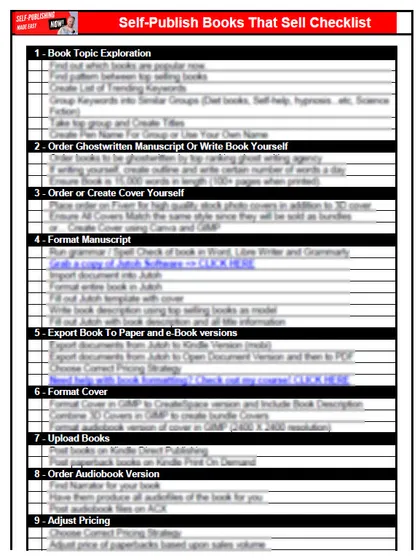
Start with the free checklist
The checklist is the 12 steps I follow for every book I publish, from choosing a topic that already sells to setting up the book's marketing. It is free, and you get it straight away.
You get the free checklist and Chris's emails. Unsubscribe any time. Privacy policy
Not sure yet? Book a free 25-minute call
Newest posts
- IngramSpark Standard vs Premium Color: Which Interior for Your Book?
- Which AI Should You Use to Write and Self-Publish a Book?
- What Can I Do Before My Manuscript Is Finished? Five Jobs to Start Now
- How Should I Title My Book's Chapters?
- Atticus or Reedsy Studio: Which Should You Use to Format Your Book?
Popular guides
- Lulu Self-Publishing Review 2026: Pros, Cons and Costs
- IngramSpark Review 2026: Free Setup, New Fees and Is It Worth It?
- Is Pegasus a Vanity Publisher? (2026 Update)
- Can You Sell Self Published Books On Etsy?
- How To Edit Your Books For Free With Grammarly
- Self Publishing Lulu VS Blurb?
- 5 Best Self Publishing Courses for Beginners (2026)
- How Long Should A Self-Published Book Be
- What Are The Minimum Amount Of Words For Paperback Books?
- Comparing Ingramspark, Lulu, and KDP Print
- How Many Books Do Self Published Authors Sell?
- Self-Publish For Under $199!