

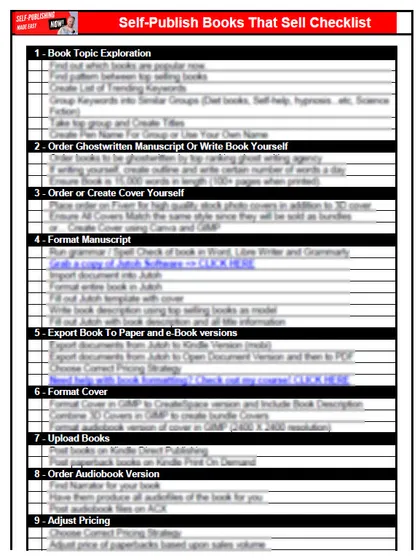
Get the free checklist: the 12 steps I follow for every book I publish.
Self-publishing a book means you publish it yourself, without a third-party publisher: you do, or coordinate, every step of getting your book on sale, and nobody approves or edits it for you. You can hire help for any step. What keeps it self-publishing is that you stay in control and keep your rights.
What does self-publishing a book mean?
Wikipedia defines it as “an author-driven publication of any media without the involvement of a third-party publisher” (Wikipedia). In practice, no company or organization has to approve your book. A platform such as Amazon’s KDP checks that your book follows its content guidelines, which ask for a positive customer experience, but it does not edit your writing or decide whether it is good. The market decides whether people want to read it.
What is the difference between self-publishing, traditional, hybrid and vanity publishing?
- Self-publishing: you control the content, price and production and pay for the services you use. You get higher royalties but no advance.
- Traditional publishing: the publisher is selective, assigns editors and designers, covers production and typically pays an advance.
- Hybrid publishing: author and publisher share costs and risk, and the author may give up some control or rights.
- Vanity publishing: the author pays for everything, often under a restrictive contract that gives up significant rights.
These definitions are summarised from Wikipedia’s self-publishing article. The words get mixed up and the confusion keeps many authors from getting a book out. If a company calls itself hybrid, read red flags with hybrid publishing companies first.
Do you have to do every step yourself?
No. Self-publishing means doing or coordinating all the steps. You can pay people for editing, the cover, the description, the title and structure, formatting, audiobook narration and even running ads, and it is still a self-published book. In fact, hiring out some steps is probably the best strategy.
The line I would draw is control. I would not hand the entire process to a company. Some authors have done that and given away the rights to their books, and then could not get them back. Stay in charge of your book.
Why choose self-publishing?
Freedom. You choose what the book looks like, what it is about, how well it is edited, how it is structured and which markets it sells on. Every key part of production is up to you.
It also pays more per sale. KDP pays a 70% royalty on Kindle ebooks priced from $2.99 to $12.99 on Amazon.com, as of 07-Jul-26 (KDP royalty options). Unless you already have a following, you will probably make more money self-publishing than through a traditional deal.
The downside is that you need to figure out the steps: cover, manuscript, formatting, where to upload, how to market and run ads. You also have to make sure the quality is good. When I started, I had ideas about organization and productivity that I wanted to put into a book, and I did not know any of this terminology. I read, watched videos, searched and asked people who had done it, and followed step-by-step instructions for the Kindle version. It took me a lot of time, which I am trying to save you. It did not happen overnight. It came from small steps every day. Starting with the manuscript, a cover and the Kindle version makes it easier to move on to paperback and audiobooks later.
If you have no time or are not comfortable with computers, another route may suit you better, and an author-published book is worth understanding too. For most people, though, I think self-publishing is the clear winner. For the cost side, see the cost to self-publish a book on Amazon.
Do I still own my book if I self-publish?
Usually yes. The US Copyright Office’s registration FAQ says your work is under copyright protection “the moment it is created and fixed in a tangible form” (no page date shown), and KDP’s copyright FAQ says that if someone is the author of an original work, “they typically own the copyright in that work” (KDP copyright FAQ). The same KDP page says you must hold the publishing rights to anything you upload. That is why the line I drew above matters: if you sell your rights to a publisher or sign them away to a service, the agreement may require you to take the book down. This is general information, not legal advice, so have a lawyer read any contract that touches your rights.
Where do you start?
Grab my free 12-step checklist so you don’t skip any step that makes your book sell.
Listen to this episode on Spotify
Frequently asked questions
Is hiring an editor or cover designer still self-publishing?
Yes. You can pay people for editing, covers, formatting, audio narration or ads and it is still a self-published book, as long as you stay in control of the book and keep your rights.
What is the difference between self-publishing and vanity publishing?
In self-publishing you control the book and choose each service. In vanity publishing the author pays for all services and often signs a contract that gives up significant rights. See self-publishing vs vanity publishing.
Do you need a publisher's approval to self-publish?
No. Nobody has to approve your book. Platforms such as KDP check that it meets their content guidelines, but they do not edit it or decide whether it is good.
Do I keep the copyright if I self-publish?
Usually yes. KDP's copyright FAQ says the author of an original work typically owns the copyright, and KDP asks that you hold the publishing rights to what you upload. If you sign rights away to a company, read the contract first.
Start with the free checklist
The checklist is the 12 steps I follow for every book I publish, from choosing a topic that already sells to setting up the book's marketing. It is free, and you get it straight away.
You get the free checklist and Chris's emails. Unsubscribe any time. Privacy policy
Not sure yet? Book a free 25-minute call
Newest posts
- IngramSpark Standard vs Premium Color: Which Interior for Your Book?
- Which AI Should You Use to Write and Self-Publish a Book?
- What Can I Do Before My Manuscript Is Finished? Five Jobs to Start Now
- How Should I Title My Book's Chapters?
- Atticus or Reedsy Studio: Which Should You Use to Format Your Book?
Popular guides
- Lulu Self-Publishing Review 2026: Pros, Cons and Costs
- IngramSpark Review 2026: Free Setup, New Fees and Is It Worth It?
- Is Pegasus a Vanity Publisher? (2026 Update)
- Can You Sell Self Published Books On Etsy?
- How To Edit Your Books For Free With Grammarly
- Self Publishing Lulu VS Blurb?
- 5 Best Self Publishing Courses for Beginners (2026)
- How Long Should A Self-Published Book Be
- What Are The Minimum Amount Of Words For Paperback Books?
- Comparing Ingramspark, Lulu, and KDP Print
- How Many Books Do Self Published Authors Sell?
- Self-Publish For Under $199!