

This post contains affiliate links. If you buy through one, Urgesta AS may earn a commission at no extra cost to you. Read the affiliate disclosure.
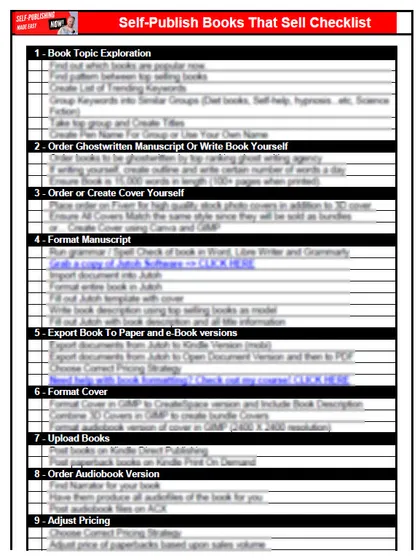
Get the free checklist: the 12 steps I follow for every book I publish.
What do you need to know to start self-publishing? Choose one market where readers are already buying, work through the basic steps in order, and keep your motivation up by staying in that one niche. You do not have to do everything perfectly: if you skip a step, do it on the next book. The rest of this post follows one author, Jerry, who was overwhelmed by conflicting advice.
Why do beginners get overwhelmed?
Because they listen to too many voices. After putting 230 books on Amazon, I know the process well, and the biggest problem I see in beginners is advice overload.
A while back I worked with Jerry, who was trying to get his first book onto the market. He was following far too many people, many of them fake gurus, who told him every step had to be done perfectly from the start. Every step was deep, there were dozens of them, and if you missed one you would fail. Jerry lost his motivation, which is why I wrote this post.
When you are getting started, remember that skipping a step is not a problem. Do it on your next book. You do not have to go back and fix all your earlier books.
Why does the market come first?
If you choose the wrong market, it does not matter how many books you publish. Either nobody is there to buy, or there are so many books that readers never find yours. When a reader searches, your book lands on page 50 instead of page one.
I remember someone I corresponded with through YouTube comments who had done exactly this. They put out pile after pile of books on, let’s say, architecture, each on a different type. I looked at the books and could see the number one problem straight away: they were not selling because nobody was buying books on those topics, even other architects. There was no hungry market.
A hungry market has readers who are buying and not too many books for them to choose from. I find one by looking at keywords. I use KDSpy to compare how many books are selling for a keyword with the total number of results for it. That ratio tells you a lot about whether your book will sell. If your books are already out and not moving, start with why your self-published books aren’t selling. If you worry about how many other writers there are, I answer are there more writers now because of the Internet.
What are the basic steps?
You need to get through the basics, not do everything perfectly. It is hard to have big success with a first book, but it is not worthless if you miss a few things. The basics are:
- Write the book.
- Order a cover.
- Choose your keywords. KDP lets you use up to seven keywords or short phrases (KDP, keywords). Reedsy puts each box at up to 50 characters and finds longer, specific phrases work better than single broad words (Reedsy, updated 21-Aug-26).
- Write the description and your author bio.
- Format the book for ebook and paperback.
- Upload it.
- Once the ebook exists, make the audiobook version if you want one.
When I work with my coaching clients, we go one step at a time and keep it simple, so nobody gets confused. You will be surprised how quickly your first book is on the market, and that builds motivation, which matters more than anything else for a self-publisher. Keep it high by not taking on too much at once and making some progress every day.
Why should you stick to one market?
Because you are building a name, not just selling a book. Other fake gurus say the opposite: throw any book out there, shoot at many markets and it will all work out. It won’t. You may find a good keyword and sell a book, but that is not a brand. The goal is for readers to think of you when they think of those books, and of those books when they think of you. You can’t do that across many markets.
The same goes for content marketing. You can’t run YouTube videos, an email list and blog posts for several kinds of books at once.
So if you love science fiction, find a popular sub-niche in science fiction with hungry readers, and write one book after another in it. When do you get to stop? For many authors, traction takes two to three years. By around ten years in one niche, your name will almost certainly be linked with that genre.
Then you start seeing regular sales. Readers recommend your books to each other, and you see reviews like “I loved his previous book, so I tried this one.” You can bundle the books together. It compounds, which is why I care so much about keeping your motivation up through each step.
If you already have books in other niches, put them under different pen names. You can run ads on them, but don’t build your marketing around them. Your main focus is one sub-niche on Amazon if you want to win in the long run.
What else do you need to know right now?
Self-publishing is a journey, not a destination. Don’t think “I have a thousand books making millions”. Think “I want to make progress every day”, and learn to enjoy the process. You already have what it takes to get a book onto the market and see sales. You can even do it for free if you need to, though I wouldn’t recommend it.
Then carve out time every day for the most important task, whether or not you feel inspired. The most important task is not more information. Too many clients want to know more and more and never get the book on the market, so I tell them I won’t help until their Kindle book is on the market, and then I help them do it. Buying information doesn’t count as progress, which is one reason some clients hire me for coaching: they need someone to hold them accountable, as I have hired coaches to hold me accountable.
New to Amazon’s platform? What Amazon KDP is and how beginners can start walks through it.
To work through the steps in order without missing anything, download my free 12-step self-publishing checklist.
Listen to this episode on Spotify
Frequently asked questions
What are the basic steps to self-publish a book?
Write the book, order a cover, format it for ebook and paperback, choose keywords, write the description and author bio, and upload it. Then do the audiobook if you want one.
How many keywords can I use on KDP?
KDP lets you use up to seven keywords or short phrases (KDP, keywords). Reedsy puts each box at up to 50 characters and finds longer, specific phrases work better than broad words (Reedsy, updated 21-Aug-26).
Should I publish in several niches at once?
No. Stay in one niche so your name becomes linked to it. If you have books in other niches, put them under different pen names and do not build your marketing around them.
Start with the free checklist
The checklist is the 12 steps I follow for every book I publish, from choosing a topic that already sells to setting up the book's marketing. It is free, and you get it straight away.
You get the free checklist and Chris's emails. Unsubscribe any time. Privacy policy
Not sure yet? Book a free 25-minute call
Newest posts
Popular guides
- Lulu Self-Publishing Review 2026: Pros, Cons and Costs
- IngramSpark Review 2026: Free Setup, New Fees and Is It Worth It?
- Is Pegasus a Vanity Publisher? (2026 Update)
- Can You Sell Self Published Books On Etsy?
- How To Edit Your Books For Free With Grammarly
- Self Publishing Lulu VS Blurb?
- 5 Best Self Publishing Courses for Beginners (2026)
- How Long Should A Self-Published Book Be
- What Are The Minimum Amount Of Words For Paperback Books?
- Comparing Ingramspark, Lulu, and KDP Print
- How Many Books Do Self Published Authors Sell?
- Self-Publish For Under $199!