
Get the free checklist: the 12 steps I follow for every book I publish.
What do you need to self-publish your book? A finished and edited manuscript, a cover, a formatted file, a description, categories and a few other details, and then you can put it on Amazon with no gatekeeper. You do not have to learn everything at once. Pedro, a 75-year-old author in Peru, is the example I use.
Why did Pedro give up on traditional publishing?
Pedro was close to giving up on publishing altogether when he asked me the question I am asked more than any other.
He lives in Peru, he is 75, and he had written a children’s book in Spanish that he had wanted to get out for a long time. He had it illustrated, and everything looked fantastic. His goal was to sit his grandkids on his lap and read it to them. He was not sure how many more years he had, so getting it out now mattered.
He wanted it traditionally published. But the main publishing houses he approached in Peru and elsewhere did not respond. He wrote to one publisher, waited, wrote again, waited, and when he finally reached them, they turned him down. From the way they rejected him, he felt it was because of his age, that a younger author would have got the deal.
People do sometimes judge you for that, and it is one more reason to self-publish: you don’t have to put up with it. Quite a few of my clients are over 70. Some call themselves old, but I have clients as old as 83. Once you have time and energy, you want those books on the market, and age should not matter. Pedro felt the gatekeepers would rather build up an author with many more years of writing ahead, however good his book was.
Then he started watching YouTube videos and other sources on how to self-publish. Many of those fake gurus made it sound very complicated, and then wanted to charge him something like 10,000 to get his book onto the market. That was far outside his budget and his patience, and he was almost ready to give up.
What do you need to self-publish?
All you need is a book. Pedro found me on Quora, where I answer questions people send me, and asked what he should do: self-publish, or keep trying for a traditional publisher? I told him self-publishing is by far the best option for him and for almost anyone starting out, as long as the book is good enough that the average reader would give it four or five stars.
Once you have the manuscript, you need:
- Editing.
- A cover. You can hire someone to design it.
- Formatting. I recommend Atticus for that.
- A description, categories and the other small bits of metadata that go with a book.
Then you are ready to publish, and you start learning the process. With no gatekeeper, there is no age discrimination and none of the other hurdles of the traditional route. You can start on Amazon straight away. After that you optimize the sales page and start running ads. If you want the bigger picture of what to focus on, read self-publishing 101: everything you need to know.
What is the just-in-time way to learn self-publishing?
Learn each step when you reach it, not before. Most people try “just in case” learning, studying everything they might need one day. I teach “just in time”: when you are ready for the next step, you learn that step.
If your book is not on the market yet, you don’t need to learn how to run ads on it. If you haven’t finished editing, there is no point learning to format. One step at a time. As you move through it, you find self-publishing isn’t that hard after all. By the time your book is live and the ads are running, you are ready for content marketing.
What is the downside of other routes?
I have never met anyone who self-published and regretted it. Every one of them told me it was a great decision, some said one of the best they have ever made. But I have met people who went the traditional route and regretted it, and people who went with hybrid publishers and lost control of their book’s rights, or kept the rights but had the book sitting in somebody else’s dashboard. They earned lower rates, and the company gave no marketing help unless they paid another thousand dollars, which mostly meant a few social media posts that sold nothing. Nobody taught them the skills to sell their own books. When you self-publish, you learn those skills as you go and get better at them.
Writer Beware, run by the Science Fiction and Fantasy Writers of America, puts it this way: “Some vanity publishers are honest and straightforward, if unduly expensive. But many aren’t, concealing their fees, breaking contract terms, and otherwise defrauding writers.” It describes hybrid publishers as “publishers that charge hefty fees but offer services equivalent to those of traditional publishers” (Writer Beware overview). If you are weighing up a publisher’s offer, I compare the routes in are self-published books better than traditional publishing?
How did Pedro get his book moving?
Pedro booked a session with me, we went through his situation, and I gave him my free 12-step checklist so he could work through the steps. Once he had it, he saw the process wasn’t so hard after all. He finished his editing, made sure everything looked right, got his manuscript formatted and ordered the cover. That is where he is now. The book isn’t on the market yet, but the cover is coming, and then we will get it uploaded together in 1-on-1 coaching. He feels great because he can see the progress.
It doesn’t all happen in a day. But once you are good at it, and you have the cover and the book ready, the formatting and posting can take an hour or two for many books. With a good formatting tool and a couple of skills, such as handling covers, you can do book after book. I list the slip-ups to watch for in self-publishing mistakes to avoid.
I work with authors of every age, from 18 to people in their 80s. What matters to me is that you get your book on the market if you have something you want to share with the world. If you need a little motivation, read success stories: the power of self-publishing.
Ready to start? Download the free 12-step self-publishing checklist and work through it one step at a time, like Pedro.
Listen to this episode on Spotify
Frequently asked questions
What do I need to self-publish a book?
A finished manuscript that has been edited, a cover, a formatted file, a description, categories and keywords. Then you upload it to a store such as Amazon KDP.
Should I wait for a traditional publisher?
Set a time limit, such as six months or two years. If a book is finished and good, it can start earning now on Amazon while you wait. Read Are Self-Published Books Better Than Traditional Publishing? for the numbers.
Can older authors self-publish?
Yes. I have clients in their 70s and some as old as 83, and there is no gatekeeper in self-publishing who can turn you down for your age.
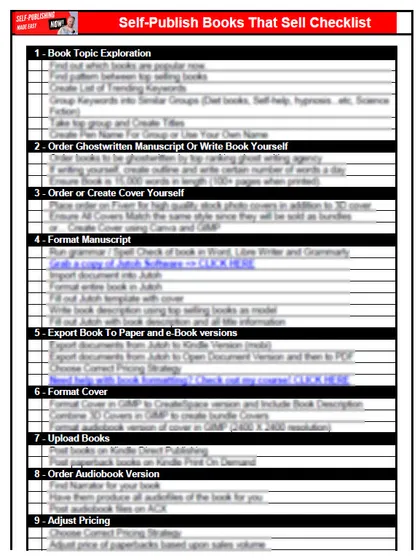
Start with the free checklist
The checklist is the 12 steps I follow for every book I publish, from choosing a topic that already sells to setting up the book's marketing. It is free, and you get it straight away.
You get the free checklist and Chris's emails. Unsubscribe any time. Privacy policy
Not sure yet? Book a free 25-minute call
Newest posts
Popular guides
- Lulu Self-Publishing Review 2026: Pros, Cons and Costs
- IngramSpark Review 2026: Free Setup, New Fees and Is It Worth It?
- Is Pegasus a Vanity Publisher? (2026 Update)
- Can You Sell Self Published Books On Etsy?
- How To Edit Your Books For Free With Grammarly
- Self Publishing Lulu VS Blurb?
- 5 Best Self Publishing Courses for Beginners (2026)
- How Long Should A Self-Published Book Be
- What Are The Minimum Amount Of Words For Paperback Books?
- Comparing Ingramspark, Lulu, and KDP Print
- How Many Books Do Self Published Authors Sell?
- Self-Publish For Under $199!