

Get the free checklist: the 12 steps I follow for every book I publish.
Yes, you can reuse the same illustration on several books if you own it or your licence covers more than one book. Most series use a different image on each cover, in the same style, so the covers match without looking identical. This post covers the licence check, what readers expect in your genre, and a cheaper way to get matching covers. For a book made of your own drawn pages, read how to self-publish a webcomic.
Before you start on covers, grab my free 12-step Self-Publishing Checklist.
Can I use the same illustration on several book covers?
The question I was sent was: can I use the same illustration for several book covers if they are part of a series, and each book has its title in a different colour? It comes up a lot with series and with books by the same author.
The short answer is yes, if you have the right to. Whether it is a good idea is a separate question, and I take that next.
Do I have the rights to reuse it?
This is the part to check first. Under US law the person who creates a work is generally its author and copyright owner. The exception is a “work made for hire”, which needs an employee or a written agreement signed by both sides for certain kinds of commissioned work (US Copyright Office, Circular 30). So paying an illustrator does not by itself make the illustration yours.
If you bought a stock image or paid an artist, read the licence. Some licences cover one book only, or limit the number of copies you can print and sell. If the licence is unclear, ask the artist or the site in writing before you reuse the image. If a lot of money rides on the series, ask a lawyer to look at the agreement. I am not one, and this is not legal advice.
I bought the original artwork. Can I publish it in a book?
Not on that basis alone. The US Copyright Office says that owning a copy of a work does not give you the copyright in it (Circular 1, Copyright Basics). It also says a transfer of exclusive rights generally must be in writing and signed by the rights owner, while a nonexclusive permission does not need a written agreement. That is US law.
My advice: owning the sketch is not the same as having the right to print it. Ask the artist, or whoever holds the rights now, for written permission that names the book and the formats before you publish, and keep it with your files. The same goes for any later book, as in the section above.
Does an AI-made cover image change anything?
If an AI tool made the cover image, KDP calls it AI-generated and you must tell KDP when you publish, even if you edited the image afterwards. If you made the image yourself and used AI only to help, KDP calls it AI-assisted and you do not have to disclose it. KDP also says you must check that the content meets its guidelines, including intellectual property rights (KDP content guidelines). Check your AI tool’s terms before you reuse its images on more books.
Should every book in a series use the same image?
Usually not. Look at a few popular series in your genre on Amazon. In my experience, the books in a series each have their own illustration, in a similar style. Your readers judge your book against how covers in that genre have looked before, so a cover that is too different from the others does not help you. It tells readers what type of book to expect.
There are exceptions. If you write a set of books on one subject, say World War II, a repeated photo or illustration can make sense.
Do matching covers sell more books?
In my experience, yes. When I started, I knew the covers had to match. If you look at my original books on Amazon under Chris A. Baird, they follow a very similar style. I found a designer whose style I liked on a freelance site, Upwork, and paid about $80 a cover for unique pictures. Prices today vary a lot, so ask for quotes. The quality was higher than I needed.
Because the style was so close across my first several books, I saw how much matching covers help. People like collecting books in a series when they look like a set. You can even show them together on a page or a screen as a set.
If you are looking for a cover designer or other help, I list some places in can you get help from online sources to publish a book.
What size must a Kindle cover be when I reuse a layout?
If you keep one layout across a series, set it up once at the right size and reuse the file. KDP asks for a JPEG or TIFF cover. The ideal size is 2,560 pixels high by 1,600 wide, the minimum is 1,000 high by 625 wide, and neither side should go over 10,000 pixels. KDP recommends a height-to-width ratio of at least 1.6 to 1, an RGB colour profile and a file under 50 MB. It also says you must hold all rights to the cover content (KDP cover image guidelines).
KDP also says a cover with a white or very light background can blend into the page, and suggests a thin medium-grey border. My advice: if your series uses a pale background, add the border to the template once and every cover in the set gets it.
How can I get matching covers for less?
A cheaper way than reusing one picture is to keep the same layout, fonts and colours, and change only the title, the colour or one element in the image. You can also ask your cover designer for a series price.
Each cover should clearly show that book’s title and author name, so readers do not buy the wrong one. In a series, number the books on the cover or in the title. Once the books are out, this guide to free marketing is a good next step.
Have you tried reusing the same image on more than one book? Tell me in the comments what happened.
Listen to this episode on Spotify
Frequently asked questions
Who owns the copyright to a cover illustration I paid for?
Usually the person who made it, unless you have a written agreement that gives you the rights. The US Copyright Office says the creator is normally the author, with narrow exceptions such as a written work-made-for-hire agreement (Copyright Office Circular 30). Get the terms in writing and check with a lawyer if the stakes are high.
Do I need to tell KDP if my cover was made with AI?
Yes, if an AI tool made the image, KDP calls it AI-generated and requires you to tell it when you publish, even if you edited the image afterwards. If you made the image yourself and used AI only to help, it is AI-assisted and you do not have to disclose it (KDP content guidelines).
Should every book in a series have its own cover image?
Most series do, in the same style. Look at the bestselling series in your genre on Amazon and match what readers there expect. See Can Authors Use Same Cover For Print And eBook? if your question is about formats instead.
Start with the free checklist
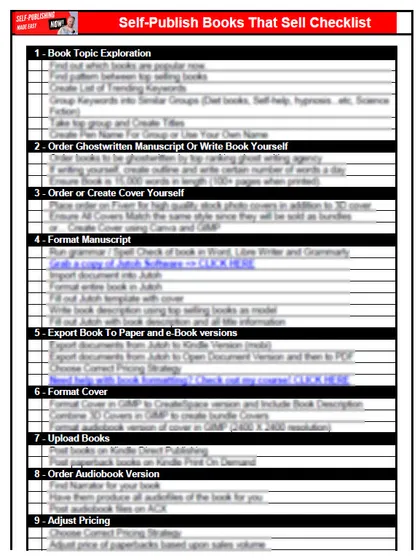
The checklist is the 12 steps I follow for every book I publish, from choosing a topic that already sells to setting up the book's marketing. It is free, and you get it straight away.
You get the free checklist and Chris's emails. Unsubscribe any time. Privacy policy
Not sure yet? Book a free 25-minute call
Newest posts
Popular guides
- Lulu Self-Publishing Review 2026: Pros, Cons and Costs
- IngramSpark Review 2026: Free Setup, New Fees and Is It Worth It?
- Is Pegasus a Vanity Publisher? (2026 Update)
- Can You Sell Self Published Books On Etsy?
- How To Edit Your Books For Free With Grammarly
- Self Publishing Lulu VS Blurb?
- 5 Best Self Publishing Courses for Beginners (2026)
- How Long Should A Self-Published Book Be
- What Are The Minimum Amount Of Words For Paperback Books?
- Comparing Ingramspark, Lulu, and KDP Print
- How Many Books Do Self Published Authors Sell?
- Self-Publish For Under $199!