

This post contains affiliate links. If you buy through one, Urgesta AS may earn a commission at no extra cost to you. Read the affiliate disclosure.
Get the free checklist: the 12 steps I follow for every book I publish.
If you can’t find a topic for your book, write down a long list of everything you find interesting, then pick the one with hungry readers and few competing books. I check that with KDSpy and a few quick looks at Amazon. And stick to one topic per pen name: my sales rose about ten times when I stopped jumping between topics. The rest of this post covers each step.
Why do you have too many ideas, or none?
The problem comes in two forms. With too many ideas you don’t know where to start, and with too few you wonder what would make money or what you are even good at. Both lead to frustration, and the one thing we don’t allow is not publishing. The goal is to get a book on the market.
When I started I wanted to write on goals, sleep, exercise and more. I wrote on sleep, goals, achievement and others, and my sales were terrible. I was not establishing myself as an expert on any single topic, and jumping around limited how many people I could reach. Asking these would have saved me that: 3 questions to ask before writing a book.
How do you choose a single topic?
Pick one topic per pen name. When I put out self-publishing books under one topic, they did much better, and my sales rose about ten times over what I had seen before. Somebody told me to use a different name for each genre or niche. A book on circus clowns, then business, then pet care leaves readers wondering who knows all of that. I also watched a YouTuber mix entrepreneurship with karate videos, which confused viewers. When they stopped, their subscribers went up.
You can still write on other topics. Use a different pen name for each, and start with one at a time. I cover how that works in pen names for authors: pros and cons. If you worry that it is all too much, read is self-publishing too complicated, and if ideas are the problem, lacking creativity to self-publish.
How do you find a topic readers will buy?
- Write a huge list of topics you find interesting, or are good at.
- Check that there is a market. You want hungry readers and few books available.
- Use KDSpy. It sits in your browser and shows estimated sales and revenue for the books, categories and keywords you look at on Amazon, and it helps me choose not just the niche but the exact words in the title.
- Take the best idea and write it, then do the next.
Here is a free check you can do right now. Type the topic into the Amazon search box and note what it suggests as you type. Then open the top five books and look at their Best Sellers Rank, how many reviews they have, and when they were published. If several are selling steadily and the newest ones have few reviews, there is room for another book. If nothing sells, pick another topic from your list.
Vappingo’s five tests for a KDP book idea (updated September 2026) put it well: are the right buyers looking for this type of book, do multiple books like it sell, can a new book realistically reach the first page, is there something to do better (reader complaints in reviews show it), and can you explain why buyers should choose yours.
How many categories can you pick for your book?
Once you have a topic, KDP asks where to shelve it. Its categories help page says you can select 3 categories when you create a book. It suggests researching similar books on Amazon and picking categories that describe your book accurately, balancing popularity against how specific they are. If no category fits, use keywords instead.
You can change them later. Open the book from your Bookshelf, go to Edit details, and edit the categories. If three are already chosen, remove one before you add another. New categories can take up to 72 hours to appear, and KDP can remove or change categories that mislead readers or do not match the content.
My advice: look at the categories the top five books in your topic use, and choose the ones where a book with your sales could reach the first page. A niche category you can win beats a huge one you cannot.
Reading age is part of the same screen. KDP says children’s categories need a reading age of 0-2, 3-5, 6-8 or 9-12, and teen and young adult categories need 13-17. If you answer yes to the sexually explicit content question, the book is not eligible for children’s categories and you cannot set a reading age. So decide who the book is for when you pick the topic, because the audience controls which shelves are open to you.
Why not write for a market that doesn’t exist?
Start from the market, then decide what you write. A starving artist writes a book on a subject nobody cares about. Someone who loves funny cat videos does not necessarily want to read a book about cats. Use your list, test each idea in KDSpy for profit, and choose from there, including the keywords in the title. Then when people search Amazon your book comes up, with a great cover and description.
Are you stuck choosing a topic? Write yes in the comments if you can’t find one, and no if you’re fine, and tell me if you have too many. It helps me decide what videos to make. If you want a method for testing your list, the first step in my free 12-step self-publishing checklist is choosing a profitable niche with keyword research.
Listen to this episode on Spotify
Frequently asked questions
What do I do if I can't find a topic for my book?
Write a long list of everything you find interesting, then pick the one with hungry readers and few competing books. Check it with KDSpy and a few quick looks at Amazon.
Should I write on several topics?
Use one topic per pen name. The author's sales rose about ten times when he stopped jumping between topics.
How do I check that a topic sells?
Type the topic into the Amazon search box, then open the top five books and look at their Best Sellers Rank, reviews and publication dates. If several sell steadily and the newest have few reviews, there is room for another book.
How many categories can I pick on KDP?
KDP lets you select 3 categories when you create a book, and you can change them later from Edit details.
Start with the free checklist
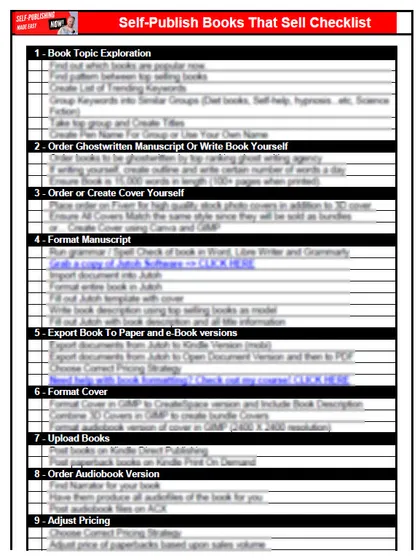
The checklist is the 12 steps I follow for every book I publish, from choosing a topic that already sells to setting up the book's marketing. It is free, and you get it straight away.
You get the free checklist and Chris's emails. Unsubscribe any time. Privacy policy
Not sure yet? Book a free 25-minute call
Newest posts
Popular guides
- Lulu Self-Publishing Review 2026: Pros, Cons and Costs
- IngramSpark Review 2026: Free Setup, New Fees and Is It Worth It?
- Is Pegasus a Vanity Publisher? (2026 Update)
- Can You Sell Self Published Books On Etsy?
- How To Edit Your Books For Free With Grammarly
- Self Publishing Lulu VS Blurb?
- 5 Best Self Publishing Courses for Beginners (2026)
- How Long Should A Self-Published Book Be
- What Are The Minimum Amount Of Words For Paperback Books?
- Comparing Ingramspark, Lulu, and KDP Print
- How Many Books Do Self Published Authors Sell?
- Self-Publish For Under $199!