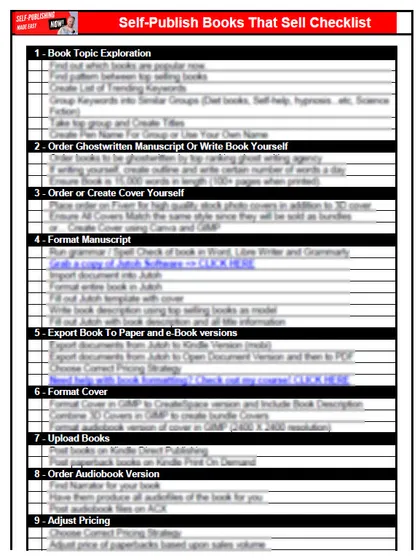
Get the free checklist: the 12 steps I follow for every book I publish.
After your first draft is complete, edit the manuscript, get a cover, format the book, and publish the ebook and a print on demand paperback. That is the simplest path, and I suggest self-publishing your first book even if you may go traditional later, because you learn every step. Congratulations on the draft: getting there is the hardest part, and many people never do. If you are not at the end of the draft yet, here is what you can do before your manuscript is finished.
What are the next steps after a first draft?
- Edit. Get the manuscript to a good standard. Do your own passes first, then bring in beta readers or a professional editor. I cover the stages in how to self-publish a book, step by step. Where to find beta readers covers how many you need.
- Get a cover. Make it yourself or hire a professional designer. Check the page count first, because a paperback cover has to match it.
- Format the manuscript. Use a tool that makes a Kindle or EPUB file and also a print on demand PDF. I recommend Atticus. KDP also accepts DOC, DOCX and PDF for ebooks, but a dedicated tool gives a cleaner result.
- Publish. Put the ebook on Amazon Kindle, and the paperback through KDP print on demand, IngramSpark or Lulu. I use all of them to maximize my royalties. KDP pays 70% on ebooks priced $2.99 to $12.99 on Amazon.com in the 70% countries (KDP royalties).
How do I price the ebook?
Amazon gives you two royalty options. On Amazon.com the 70% option needs a list price from $2.99 to $12.99, a band that took effect on 07-Jul-26 (it was $2.99 to $9.99 before). The 35% option covers prices from the file-size minimum up to $200, and the minimum is $0.99 for files under 3 MB, $1.99 for 3 MB to under 10 MB and $2.99 for 10 MB or larger. Delivery costs still apply to the 70% option, and other countries have their own price bands (KDP eBook list price requirements, September 2026). For the paperback, KDP shows your estimated royalty for each marketplace as soon as you enter a list price (KDP paperback pricing).
My advice: set the price after you see the royalty figure, not before, and do not worry about getting it perfect. You can change it later. A price that is too high can stop a first sale, and one that is too low can cost you royalties, so pick a sensible middle and watch what happens over the first month.
What happens after I hit publish?
Publishing is the start of selling, not the end of it. Plan a few weeks of simple promotion, such as telling your email list and asking friends for honest reviews. My advice is to begin the next book while the first one is still fresh, because the second book is easier and more books give readers more to buy.
Should I order a proof copy before I publish the paperback?
Yes, for a paperback I would. KDP’s Proof and Author Copies page says a proof copy is a test copy you review before you submit the book for publication. It carries a “Not for Resale” watermark and a barcode with no ISBN, so it is not for selling. Neither proofs nor author copies earn royalties or show in your KDP Reports. An author copy is different: it is a print of your live book, sold to you at print cost, and you may resell it or give it away.
My advice is to read the proof with a pen, from the first page to the last, as a reader would. Look at the cover colors, the margins and the page numbers. An ebook has no printed proof, so use the previewer in your formatting tool for that.
Should I self-publish my first book?
Yes, I’d suggest it. A traditional publisher is a different process, and with self-publishing you learn the steps that every book needs. To set your expectations on money, you can look up how much self-published books make before you decide.
I wrote a draft in November. What now?
A lot of first drafts get finished in a November writing challenge. The best known one, NaNoWriMo, has closed: The A.V. Club reported on 01-Apr-25 that the organization was shutting down after years of struggling to sustain itself financially. Writers still set their own month-long goals, and the steps after the draft are the same whichever challenge you used.
- Let it rest. Put the draft away for a week or two. You will read it with fresher eyes, and the weak spots are easier to see.
- Do a first read-through. Read it start to finish without fixing anything. Make notes on the big things, such as a slow middle or an ending that needs more. Fast drafts usually have gaps, and that is normal.
- Revise on your own. Fix the big problems first, then the sentences. Save the spelling and small tweaks for last.
- Bring in beta readers. Once you have done what you can alone, ask a few readers for honest feedback. Where to find beta readers explains how.
- Edit. Then hire an editor or do a careful final edit. If you want a report on your draft first, see my manuscript review.
- Cover, formatting, publish. These come after the edit, in the order of the steps above.
My advice: don’t rush to publish in December just because the draft is done. A rested, revised book will serve you better than a fast one. The draft is the hard part, and you have already done it.
How do I keep it simple?
There are many ways to do this, and some people spend so long finding the best one that they never publish. Pick a simple standard path and take one step at a time. Don’t try to do everything at the same time. My free 12-step self-publishing checklist lists the steps in order without the fire hose effect.
I have put out 230 books on Amazon, many of them also on IngramSpark, and most on Audible and similar places. I started simply, with the Kindle format. Each new book teaches you something, and you can take your first book back and apply it, because you can edit your ebook after it is published.
What is the most challenging next step for you? Tell me in the comments.
Listen to this episode on Spotify
Frequently asked questions
Should I edit before I make the cover?
Edit first, because changes to the text can change the page count and the cover spine. A paperback cover needs to match the final page count.
Do I need to write the book myself?
No. You can write it yourself or have a ghostwriter write it. Either way, once you have the draft you are at the same step.
Can I just use Word to make the ebook?
KDP accepts DOC and DOCX files, but a dedicated tool such as Atticus gives a cleaner result and also makes the print file.
Start with the free checklist
The checklist is the 12 steps I follow for every book I publish, from choosing a topic that already sells to setting up the book's marketing. It is free, and you get it straight away.
You get the free checklist and Chris's emails. Unsubscribe any time. Privacy policy
Not sure yet? Book a free 25-minute call
Newest posts
Popular guides
- Lulu Self-Publishing Review 2026: Pros, Cons and Costs
- IngramSpark Review 2026: Free Setup, New Fees and Is It Worth It?
- Is Pegasus a Vanity Publisher? (2026 Update)
- Can You Sell Self Published Books On Etsy?
- How To Edit Your Books For Free With Grammarly
- Self Publishing Lulu VS Blurb?
- 5 Best Self Publishing Courses for Beginners (2026)
- How Long Should A Self-Published Book Be
- What Are The Minimum Amount Of Words For Paperback Books?
- Comparing Ingramspark, Lulu, and KDP Print
- How Many Books Do Self Published Authors Sell?
- Self-Publish For Under $199!