

I was working with Gary in my one-on-one program. We were meeting on Zoom and going through the phases of publishing. Gary had been through the process before, but he wanted to try rapid publishing. Can you get a book out fast, or does it really take years?
He hit a few snags, and they made it impossible for him to hit 72 hours. He had done other books, but he had outsourced everything, so there were steps he had never learned himself. It took a lot longer than 72 hours.
Is it possible? Of course it is. These are the steps Gary was missing, and they are what make it fast.
Why try a sprint at all
After publishing 200 plus books on Amazon, IngramSpark and other sites, I have learned that a sprint is a good exercise, even if you have published a hundred books. It works the way NaNoWriMo does, where people write 50,000 words in the month of November. Sometimes you sit around waiting for inspiration, and a short, fixed amount of time is what gets you moving.
If it is your very first book, a 72-hour sprint will not be easy. Sometimes it is still worth the effort. For the sprint I am assuming you already have a manuscript. Some people can pound a book out very fast, and if you can, that can be part of your 72 hours. I would still start with a manuscript in hand.
Step 1: the cover
Get your cover first. Go to your designer with examples of covers that are close to what you want. A designer who works from covers you like will get you there faster than one starting from a blank page.
If you are on a sprint, ask about rush delivery. Normally a cover takes about three days, and for an extra fee you can get it in 24 hours. A good cover from a good designer is cheap compared to what it can earn. Some of my covers have sold thousands of books.
Step 2: run the manuscript through Grammarly
Run the manuscript through Grammarly in Word. Often I hired editors to go through a book and they found a number of things. Even after I fixed all of it, Grammarly found additional mistakes they had missed.
I have had many clients show me their manuscript, and I would ask whether they had run it through Grammarly. They said no. I put it in and showed them all the errors. Readers react quickly to spelling and basic grammar. If those problems are all over the book, your readers will not get the experience they should. You can test Grammarly for free, so there is no reason to skip it.
Step 3: a title and cover that say who and what
Now you have a cover and a clean manuscript. Check that the title is good. I use KDSPY to find the keywords for a title. If you do not want to use a tool, look at the bestsellers in your genre and see which keywords they use.
Someone looking at your cover and title should know quickly two things: who the book is for and what it offers. If they cannot tell, the book will not sell. A sprint is not an excuse to put garbage on the market. You want a book people like and give five stars, or at least four. If reviews come in under four, something needs fixing.
Step 4: format it yourself
This is the secret of the day. If you hire someone to format, you will have a lot of changes and a lot of back and forth. If you do it yourself, the speed is a different thing. I could take your manuscript and have it formatted for your paperback and Kindle version in about ten minutes.
I used to do this with a different tool, and today I recommend Atticus for formatting. Whichever tool you use, you should know it before you start a sprint. That is one reason this may not be the right exercise for your first book. After a couple of books, 72 hours is more time than you need.
After the book is live
People ask what the point is of getting a book out so fast. When it starts to make sales, you put that money back into training and tools, and into getting more books out quickly. The more you publish, the faster you get at it.
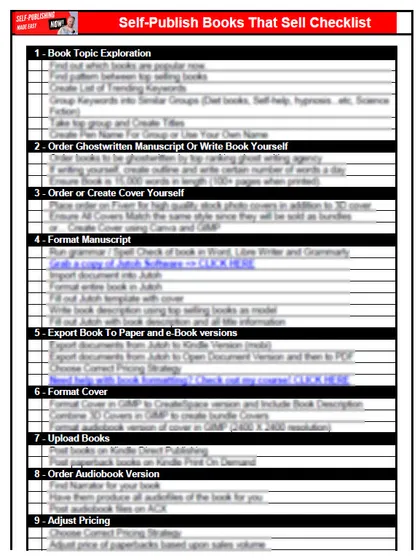
Many self-publishers underestimate this. They think the first book was hard, so the next one will be too. The next one goes about ten times faster. Eventually you are working through a checklist, like the one I give away free, and it becomes automatic. You almost do not need to look at it, although I still go through it item by item.
Stick with a single niche, and make sure it is profitable. If you are not sure whether yours is, book a discovery session with me and we will look at it together.
The thing you need going in
You need focus. If you are asking where the focus for writing comes from, I have a post on that too: Where Does the Focused Writing Come From?
If you want to see how fast the writing itself can go, read my post on writing a book in less than 24 hours. And if you are wondering whether Grammarly is worth paying for, read my Grammarly review.
Your turn
Have you tried a publishing sprint? What slowed you down? Tell me in the comments.
If you want help planning one, book a free 25-minute discovery call. You can also start with my free 12-step self-publishing checklist.
Start with the free checklist
The checklist is the 12 steps I follow for every book I publish, from choosing a profitable niche with keyword research to setting up the marketing machine. It is free, and you get it straight away.