

Self-publishing looks like a mountain of steps until you see it laid out. Here is the shortest route I know, with the one step most authors skip.
I’ll start with a client, because his story is common.
Ted wanted to be chosen
When I first started group coaching, I ran it on Facebook and a few other platforms before moving to the one I use now. One of my clients then, Ted, was stuck on a single question. He was desperate to get his book picked up by a traditional publisher. When I asked why, he said he did not feel like a real author unless a publisher had selected his book.
I hear that a lot. You have written something and you feel like someone dabbling. But you are an author once your book is published, whether a publisher chose it or you did it yourself.
Ted had been trying for a long time and he was getting frustrated. He also told me self-publishing had too many steps and was too confusing for him. He was wrong about that. Coaching is partly for exactly this, finding the barriers and the limiting beliefs and taking them away one at a time as we go.
Step 1: get a manuscript
You need a book. You might write it yourself. You might pay a ghostwriting company to write it. Or it might be a book somebody in your family wrote, even a child, that you want to get onto the market. You do not have to start with something you wrote.
Step 2: format it and have it edited
The manuscript needs to be formatted for the platform and edited so it is free of mistakes. Run it past an editor, or at least a proofreading tool. A clean file is the point of this step.
Step 3: get a cover
A cover designer takes this one off your hands. Show the designer covers you like and have them make yours in that style. I come back to the cover below, because it has a job to do beyond looking nice.
The step that decides whether it sells: title and subtitle
Those three steps get the book out. The thing that most affects whether it sells is the title and subtitle, matched with the cover. It is also the hardest part and the one that takes the most work.
If you do a discovery session with me, or join the one-on-one program, the first thing I ask is whether we can find the top competitors for the book you have in mind. I want to know what market it goes into.
Remember that it is not a market if you are the only one with a book there. A market has sellers and buyers. People sell puppy training books, and people with puppies buy them. What you want is a market with not many sellers and a lot of buyers, and Amazon gives you that information for free. I use KDSPY as my number one tool for it.
What a reader sees before they click
A reader sees your cover, title and subtitle, and the reviews, and has one decision to make, which is whether to click. On the Amazon search results page you do not get a buy button on most books. You have to click through to the sales page, where the description, the author bio, the reviews and the prices are. If the title, subtitle and cover are off, nobody ever gets there.
Done right, your ideal reader knows in a second what kind of book this is, what it offers and why to buy it. It might be a paranormal romance or a puppy training book. The cover tells them fast, and it only works if it looks like the best sellers in your sub-genre.
Look at those best sellers and you will see the pattern. The colours are alike. The fonts are alike. There may be a person on the cover, or it may be a drawing. Within a sub-genre they nearly all follow the same one.
The research I do
I use KDSPY on the best sellers in the sub-genre. I look at the titles and subtitles and at the word clouds to see which words show up in all of them. That tells me what to put in the title of my next book.
Then I take the main keyword I have in mind and check two numbers. One is how many books come up for it in the search results, for Kindle books or paperbacks. The other is how many of those are in the top 100,000 books on all of Amazon.
If you can, do this research first. I put it third on the list, which is a bit crazy, because in a perfect world it comes before you write a word. You want hungry readers who want more of something and cannot get it, which pushes prices and sales up and lets you charge more.
Most authors skip it. They publish, nothing sells, and they cannot see why. Nobody can tell what value the book offers, or the book never shows up for anything they search. You are not targeting keywords that anyone is typing.
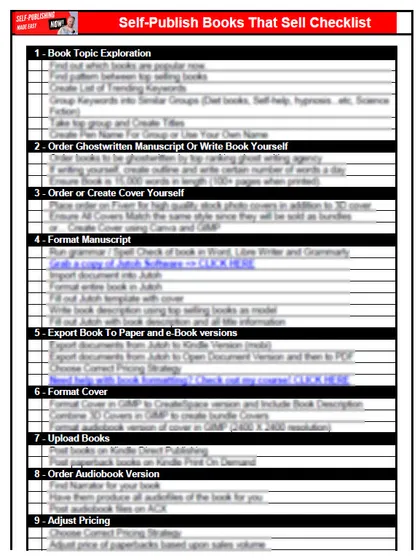
If you want help with this, book a free 25-minute discovery call and we will look at your book together. Or start with my free 12-step self-publishing checklist.
Start with the free checklist
The checklist is the 12 steps I follow for every book I publish, from choosing a profitable niche with keyword research to setting up the marketing machine. It is free, and you get it straight away.